
The Best Fluffy Pancakes recipe you will fall in love with. Full of tips and tricks to help you make the best pancakes.

A cucumber salad dressed with tart yogurt and lots of chopped dill and mint makes a cooling, pleasantly refreshing saucy accompaniment to grilled meat. This is a handy brightly flavored salad to make all summer long, and so simple
e “bird” refers to chicken by default in culinary contexts.
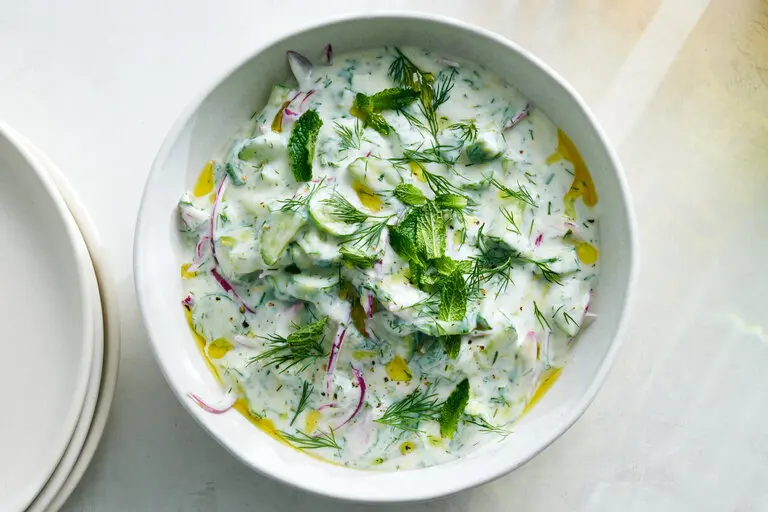
Ingredients
Yield:6 to 8 servings
- 3cups diced or thinly sliced Persian cucumber
- Salt and black pepper
- Pinch of ground cayenne
- 1tablespoon finely chopped serrano chile (optional)
- 3cups plain whole-milk yogurt
- ½ cup thinly sliced red onion
- 2small garlic cloves, pounded to a paste or grated
- 1small lemon, zested and juiced
- ½ cup roughly chopped dill, plus fronds for garnish
- ½ cup roughly chopped mint, plus leaves for garnish
- 2tablespoons olive oil
Preparation
- Step 1Place cucumbers in a serving bowl and season well with salt and pepper. Add cayenne and serrano chile (if using), and toss.
- Step 2Add yogurt, onion, garlic, lemon zest and juice. Using a spatula, mix everything well. Taste and add more salt as needed.
- Step 3Stir in chopped dill and mint, and refrigerate until ready to use.
- Step 4To serve, garnish with dill fronds and mint leaves, and drizzle with oli
How to Make
- Prepare the cucumber
Grate or finely chop the cucumber. Lightly squeeze out excess water to avoid watery yogurt. - Whisk the yogurt
In a bowl, whisk the yogurt until smooth and creamy. - Mix everything
Add cucumber, salt, cumin powder, and pepper/chili powder. Mix well. - Garnish & chill
Add coriander or mint. Chill for 10–15 minutes before serving.
Tips for Perfect Cucumber Yogurt
- Use thick yogurt for best texture
- Add a little garlic paste for a dip-style version
- For crunch, sprinkle boondi or roasted peanuts
- Don’t over-squeeze cucumber—keep it fresh, not dry
Serving Ideas
- With biryani, pulao, or paratha
- As a cooling side for spicy meals
- As a dip for wraps or grilled veggies
- Texture & Flavor: It is creamy,, crunchy, and refreshing, with a cooling effect on the palate.
- Key Ingredients: The foundation is thick yogurt or strained Greek yogurt mixed with diced, grated, or julienned cucumbers.
- Flavor Boosters: Common additions include minced garlic, fresh mint, fresh dill, lemon juice, olive oil, and sea salt
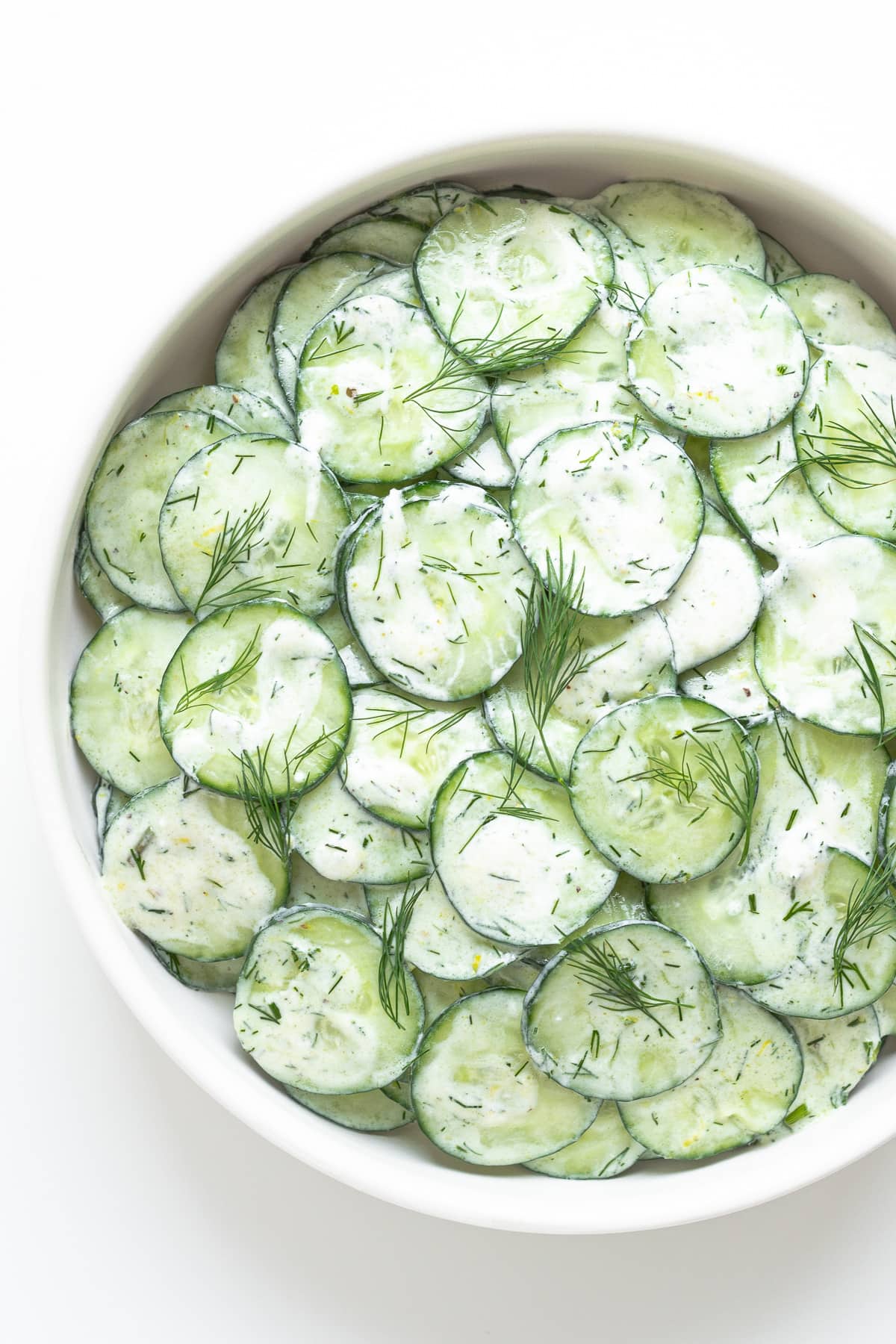
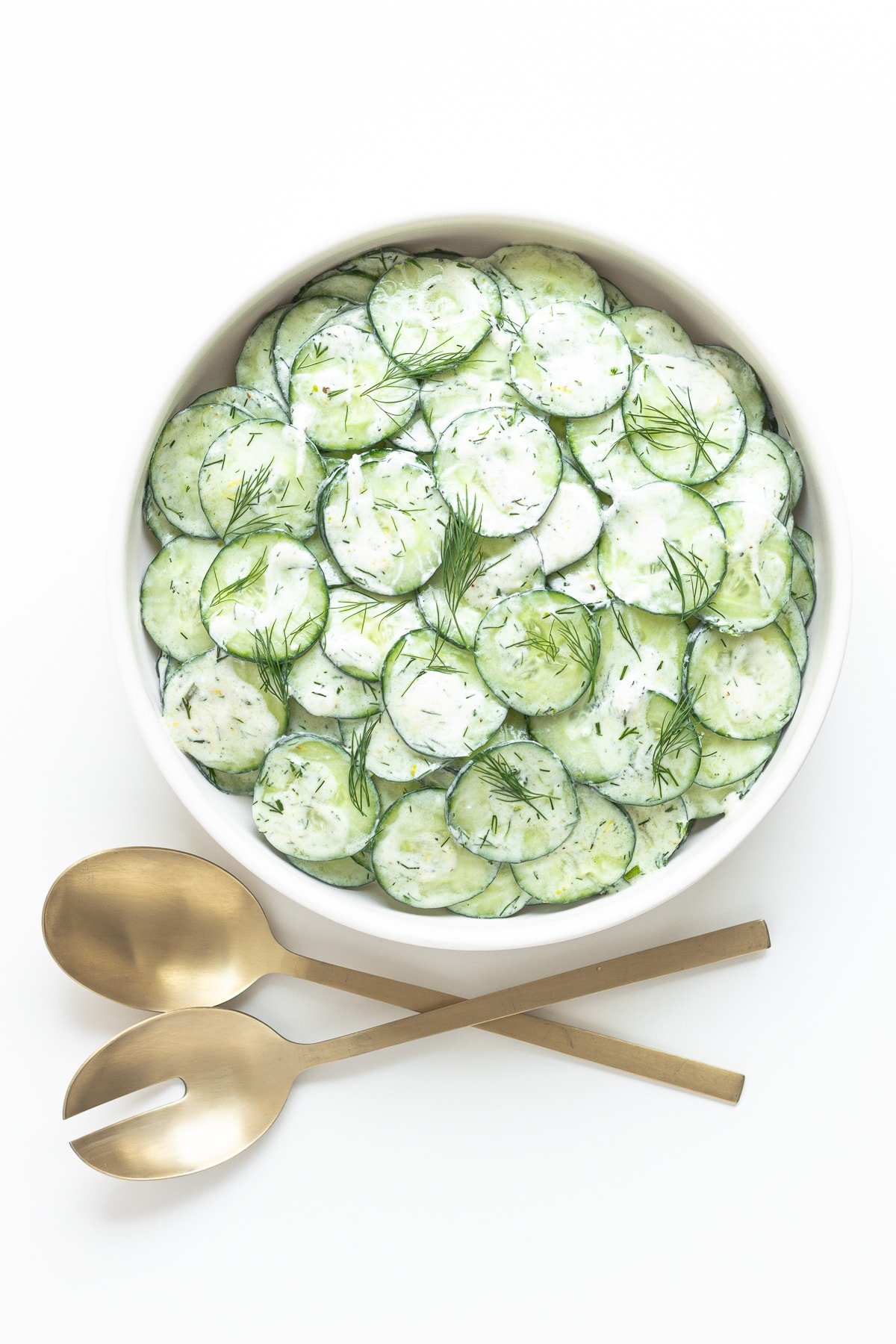
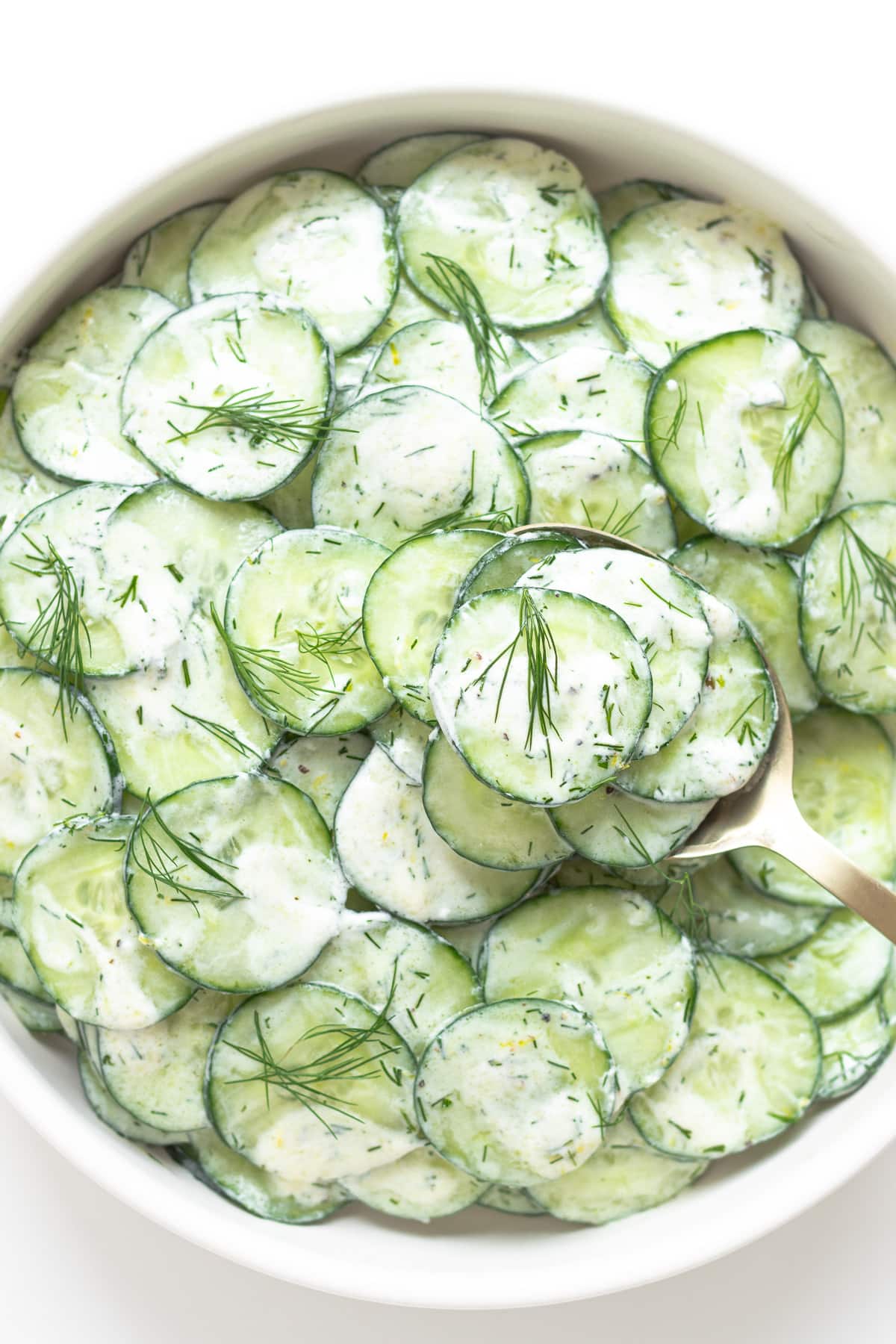
- This refreshing Cucumber Yogurt Salad recipe features all the flavors of tzatziki in salad form. It’s loaded with crunchy cucumbers, creamy Greek yogurt, fresh dill, garlic and lemon. A quick and easy side dish that is SO GOOD!
ngredients You’ll Need
Just a few simple ingredients are needed to make this delicious salad…
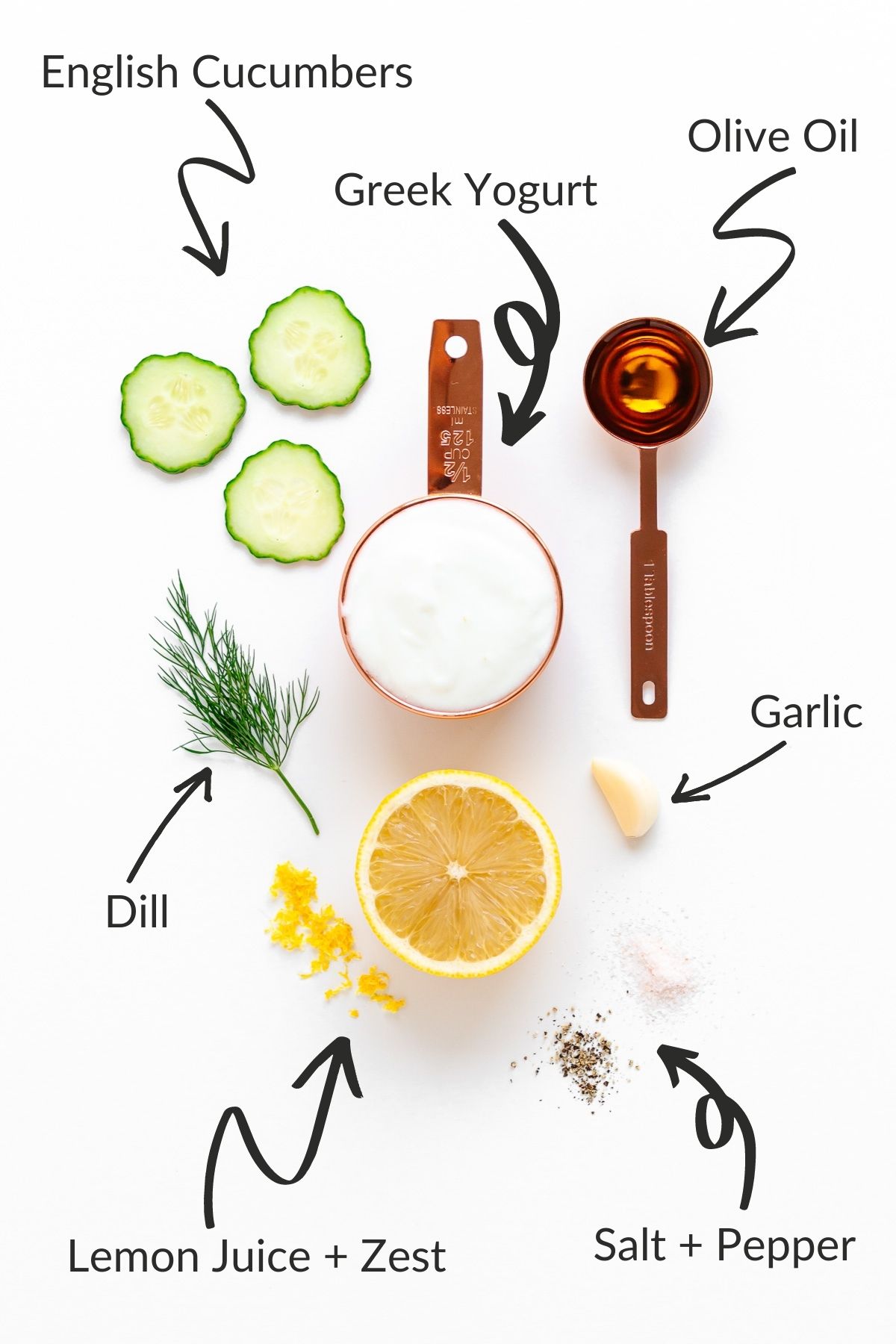
- Cucumbers: I like to use English cucumbers since they are seedless and do not need to be peeled.
- Greek Yogurt: Or any type of plain yogurt. I prefer to use a full-fat variety for the creaminess, taste and texture.
- Dill: Freshly chopped dill adds so much fresh flavor.
- Lemon: Zest and juice of half a lemon for added brightness and acidity.
- Extra Virgin Olive Oil: A little bit adds to the creaminess and brings the dressing together.
- Garlic: I like to use one clove of minced garlic but feel free to use more if you like it extra garlicky.
- Salt + Pepper: Some salt and freshly ground pepper to season it up!
How To Make Cucumber Yogurt Salad
This creamy yogurt dill cucumber salad is super easy to make. Simply…
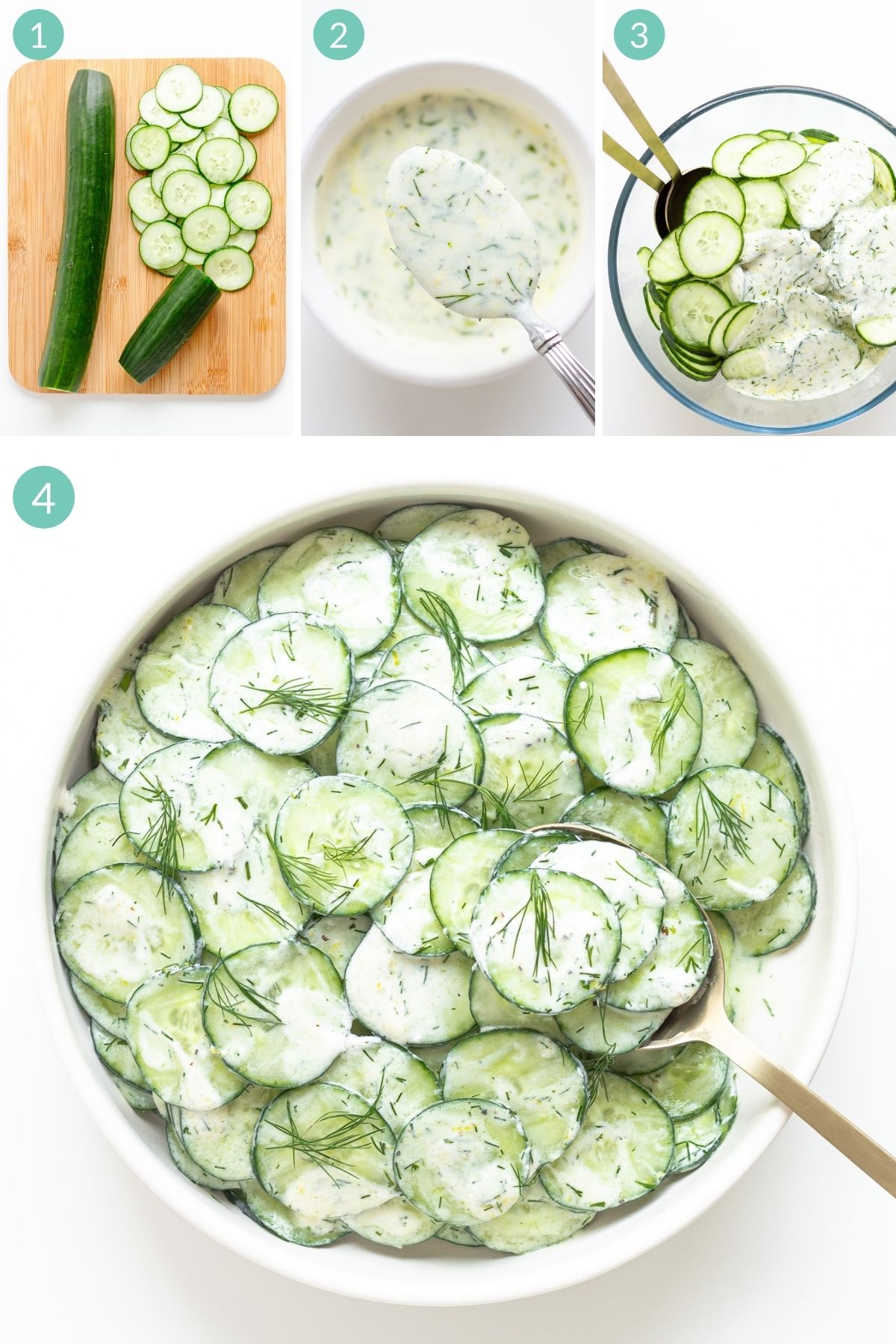
- Slice: Thinly slice the cucumbers. You can use a mandoline, slicing side of a box grater, food processor with a thin slice attachment or a sharp knife. If using a mandoline, I also recommend some cut resistant gloves for safety.
- Make Dressing: In a small bowl, stir together the remaining ingredients.
- Mix Together: Add the cucumber slices and dressing to a mixing bowl. Toss to combine.
- Serve or Chill: Serve immediately or refrigerate for 30 minutes before serving.
- Spiralize it
Do you have a spiralizer? For a fun presentation idea, you can also spiralize the cucumbers into flat ribbon shapes. Use scissors to cut the spiralized cucumbers into pieces that are more manageable to eat.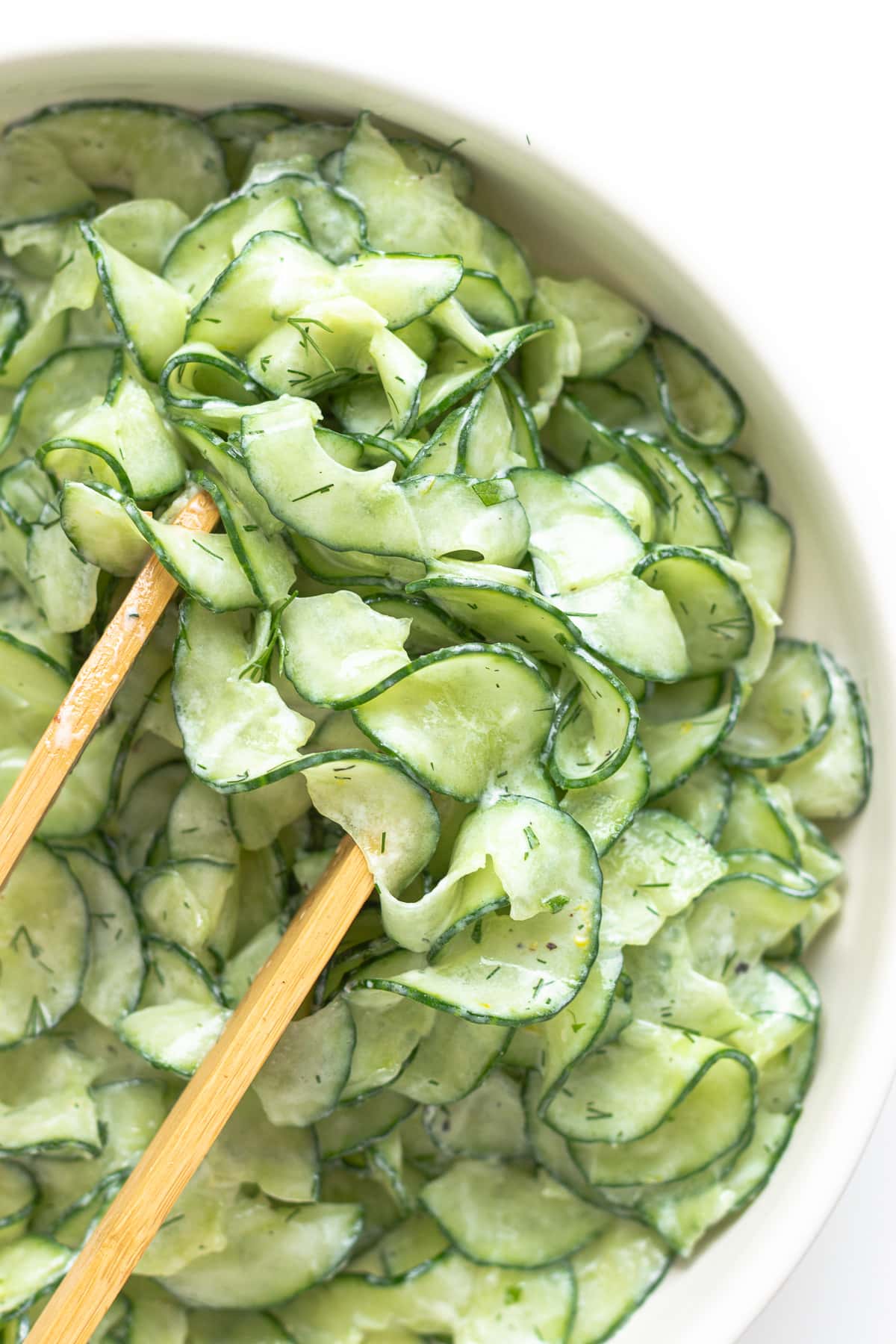
Possible Variations
Salads are so easy to customize. Here are a few ideas…
- Use different type of cucumber: Instead of English cucumbers, you could also use Persian, Lebanese or field cucumbers instead. You will need to use more cucumbers if using a smaller variety. If using field cucumbers, make sure to peel them, slice in half vertically and scoop out the seeds before slicing since this variety has seeds and a tougher skin.
- Add extra veggies: Onions, sliced radishes, etc.
- Use different herbs: Parsley, chives or mint would all be delicious.
What To Serve It With
This cucumber yogurt salad recipe is a simple, refreshing side dish that is delicious served alongside…
- Grilled foods: This is a great summer salad since it pairs well with grilled foods like steak, chicken kebabs, sausages, grilled salmon, shrimp skewers and more.
- Spicy or rich foods: A refreshing and cooling side dish for any spicy or rich dish.
- Meat + Seafood: Delicious side dish for roasts like this Herb Crusted Roast Beef, chicken, pork tenderloin, fish, or these Easy Pan Seared Shrimp.
- Greek + Mediterranean food: Excellent side dish for all your Greek or Mediterranean favorites.
We independently select these products—if you buy from one of our links, we may earn a commission. All prices were accurate at the time of publishing.
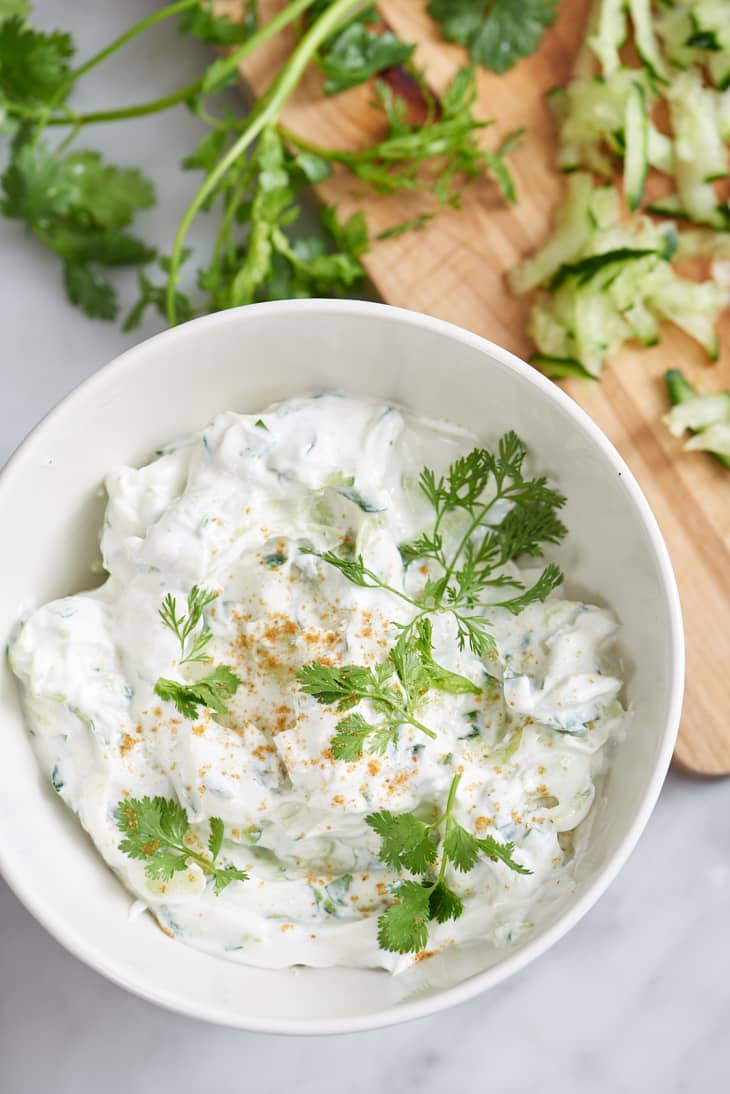
Oh, do I ever have a sauce for you today! Raita is just the sort of cooling, contrasting sauce that all of your summer grilling food needs. Warm with cumin, and studded with crisp cucumber and fresh cilantro, this yogurt sauce is welcome on everything from naan-wiches to grilled watermelon. This warm-weather-friendly sauce is one we think you should know by heart, for making all year long.

What Is Raita?
Raita is mixture of yogurt, fruits or vegetables, and fresh herbs and spices used a sauce or condiment. Indian raita is commonly made with dahi, a salted yogurt, and chopped cucumbers spiced with cumin or mustard seeds and fresh herbs. Variations abound, including those made with mango, tomato, or red onion in addition to or instead of the cucumber.How to Easily Poach an Egg
Yogurt, however, is not optional. Chatting with Deepa Thomas, author of Deepa’s Secrets: Slow Carb New Indian Cuisine, I learned the importance of raita in Indian cuisine — for flavor and health. “Raita is an anchor piece of Indian table and home cooking, not just because of its cooling affect on spicy food, but also because it aids in digestion.”
Essential Steps for Raita
- Use fresh toasted and ground spices. Look, I love my pre-ground spices for most weeknight cooking, but raita really does taste better when you toast the spices just before making it. Spices like whole mustard seeds can be left intact or ground.
- Grate and drain the cucumber. Use the large holes of a box grater to “cut” the cucumber for raita and squeeze as much moisture out of the cucumber as possible by gathering it in a clean kitchen towel and wringing the towel around the cucumber. Don’t discard that cucumber liquid — it makes a damn fine lemonade addition.
- Season the yogurt well. Since traditional raita is made with dahi or salted yogurt, it is essential that your plain grocery store yogurt gets a healthy dose of salt before serving the raita.
What’s the Difference Between Raita and Tatziki?
Raita and tzatziki share two similar base ingredients and some similar steps, but they are distinctly different. First, raita starts with dahi, a thinner salted yogurt, while tzatziki starts with thicker plain Greek yogurt. Tzatziki also has a heavy dose of lemon juice, making it decidedly more tangy than raita. Both pair well with heavily spiced, toasted, and grilled foods and can be served as either a dip or condiment.
How to Serve Raita
We’re all sort of obsessed with serving raita on this naan-wich, but at home I love serving it over grilled salmon or on curried sweet potatoes. You can smear raita onto sandwiches or wraps or even just on top of naan bread for a quick snack. Spoon raita onto soups or curries just before serving or over quickly scrambled eggs in the morning.
Cucumber Yogurt Rice, often known as a variation of South Indian Curd Rice (Thayir Sadam) or Cucumber Raita with Rice, is a refreshing, cooling, and easy-to-make dish perfect for hot summer days or as a light meal. It combines cooked, mashed rice with yogurt, grated cucumber, and a spiced tempering (tadka).
Cucumber yogurt rice (often known as Kakdi Dahi Bhaat) is a refreshing, cooling, and nutritious South Indian-inspired dish blending cooked, mashed rice with creamy, plain yogurt and finely grated or chopped cucumbers. Often served cold, it features a tempered oil seasoning of mustard seeds, curry leaves, and green chilies, offering a hydrating, savory, and soothing meal.
ucumber Rice Recipe (Indian Style)
Ingredients
- 2 cups cooked rice (cooled)
- 1 medium cucumber (grated or finely chopped)
- ½ cup thick yogurt (optional but recommended)
- Salt to taste
For tempering:
- 1 tbsp oil
- ½ tsp mustard seeds
- ½ tsp cumin seeds
- 1 green chili (finely chopped)
- 1 tbsp peanuts or cashews
- 6–8 curry leaves
- A pinch of asafoetida (hing)
Optional garnish:
- Chopped coriander
- Lemon juice (few drops)
How to Make
- Prepare the rice
Spread cooked rice on a plate and let it cool completely. This prevents it from becoming mushy. - Add cucumber & yogurt
Mix grated cucumber with rice. Add yogurt and salt, and gently combine. - Make the tempering
Heat oil in a pan. Add mustard seeds (let them splutter), cumin seeds, peanuts/cashews, green chili, curry leaves, and hing. - Mix & finish
Pour the hot tempering over the rice. Mix well. Garnish with coriander and a few drops of lemon juice if you like.
Tips for Perfect Cucumber Rice
- Always use cooled rice
- Squeeze excess water from cucumber
- Skip yogurt for a lighter, non-curd version
- Add grated coconut for extra flavor
Serving Suggestions
- Serve chilled or at room temperature
- Pairs well with pickle, papad, or curd chili
- Great for lunchboxes and summer meals
A quick and delicious recipe especially if you have any leftover rice in the fridge. It’s fragrant and delicious, and even if you don’t have any cooked rice to hand and need to start from scratch. This will very simply satisfy your soul and is a great cure for when you are feeling low and don’t have a great appetite. Courtesy of Cyrus Todiwala.
How to make Yogurt Rice With Cucumber, Tomato & Fried Peanuts
- If cooking the rice, cook according to the packet instructions, drain and cool. Refrigerate once cooled to chill completely.
- Place the coriander, chilli powder and turmeric in a small bowl and make a thin paste with the water. Cover and set aside.
- Heat the oil in a frying pan over a medium heat. Fry the peanuts for a minute or so, stirring regularly, then drain in a sieve placed over a bowl. Return the oil to the frying pan and heat again.
- Once the oil is hot and hazy, add the mustard seeds and cover the pan loosely to prevent them from popping all over the place. As soon as they start to settle in the pan, add the cumin seeds, the white lentils, curry leaves and the green chilli and cook until the daal changes colour. Immediately add the asafoetida powder, if using, sauté for a few seconds, then add this tadka mixture to the yogurt, scraping the pan.
- Add the onion, tomato and cucumber to the yogurt and mix well. Stir in the fresh coriander and some seasoning.
- Mix the rice into the yogurt and taste for seasoning. Some people like to add a bit of sugar at this point, but it is completely optional.
- Serve the rice cold, topped with the fried peanuts.
- Curd rice is a popular South Indian comfort meal made with soft cooked rice, mixed yogurt, and tempered with spices. This recipe needs only a few ingredients and it’s OK if you do not have some ingredients, like hing or curry leaves. The final dish will still be equally delicious.
- Key Ingredients & Components
- Rice: Cooked soft and slightly mashed, ideally using a soft rice variety like Sona Masoori.
- Yogurt (Curd): Fresh, non-sour plain yogurt.
- Cucumber: Grated or finely chopped (typically 1 medium).
- Tempering (Tadka): Ghee or oil, mustard seeds, cumin seeds, curry leaves, green chillies, and sometimes hing (asafoetida) or urad dal.
- Optional Enhancements: Pomegranate seeds, coriander leaves, grated carrot, or grated ginger
- 🥒🥣 Health Benefits of Cucumber Yogurt
- Cucumber yogurt is not just refreshing—it’s packed with simple, everyday health benefits that make it a smart addition to your meals.
- 🌿 1. Keeps You Cool & Hydrated
- Cucumber has a high water content, and yogurt cools the body naturally. Together, they help prevent dehydration, especially in hot weather.
- 🧘 2. Aids Digestion
- Yogurt is rich in probiotics that support gut health, while cucumber is light and easy to digest—great for reducing acidity and bloating.
- 🦠 3. Boosts Gut & Immune Health
- The good bacteria in yogurt strengthen digestion and immunity, helping your body absorb nutrients better.
- ❤️ 4. Supports Heart Health
- Cucumber provides potassium, which helps regulate blood pressure, while yogurt can support healthy cholesterol levels when consumed regularly.
- ⚖️ 5. Helps with Weight Management
- Low in calories, high in nutrients, and filling—cucumber yogurt is ideal for weight-conscious diets and healthy meal plans.
- ✨ 6. Good for Skin Health
- Hydration from cucumber and probiotics from yogurt can improve skin texture, reduce dullness, and support a natural glow.
- 🔥 7. Soothes Acidity & Spicy Food Effects
- Cucumber yogurt helps neutralize stomach acid and calms the digestive system after spicy or heavy meals
Avocado Raita (Avocado Yogurt Dip)
Mango Shrikhand (Indian Sweetened Mango Yogurt)
Shrikhand (Indian Sweetened Yogurt)
Chana Masala Tacos with Cucumber Salsa
Greek Cucumber Salad
Boondi Raita
Masala Chaas Recipe • Spiced Greek Yogurt Drink (High-Protein)
Mint Raita
Cucumber Raita is a creamy, crunchy Indian dip made with yogurt, chopped cucumbers, fresh herbs, and mild spices. This refreshing and cooling condiment is a must-have with biryani, pulao, and many Indian meals. Here’s a 10-minute recipe that can be made ahead of time, and is best served chilled.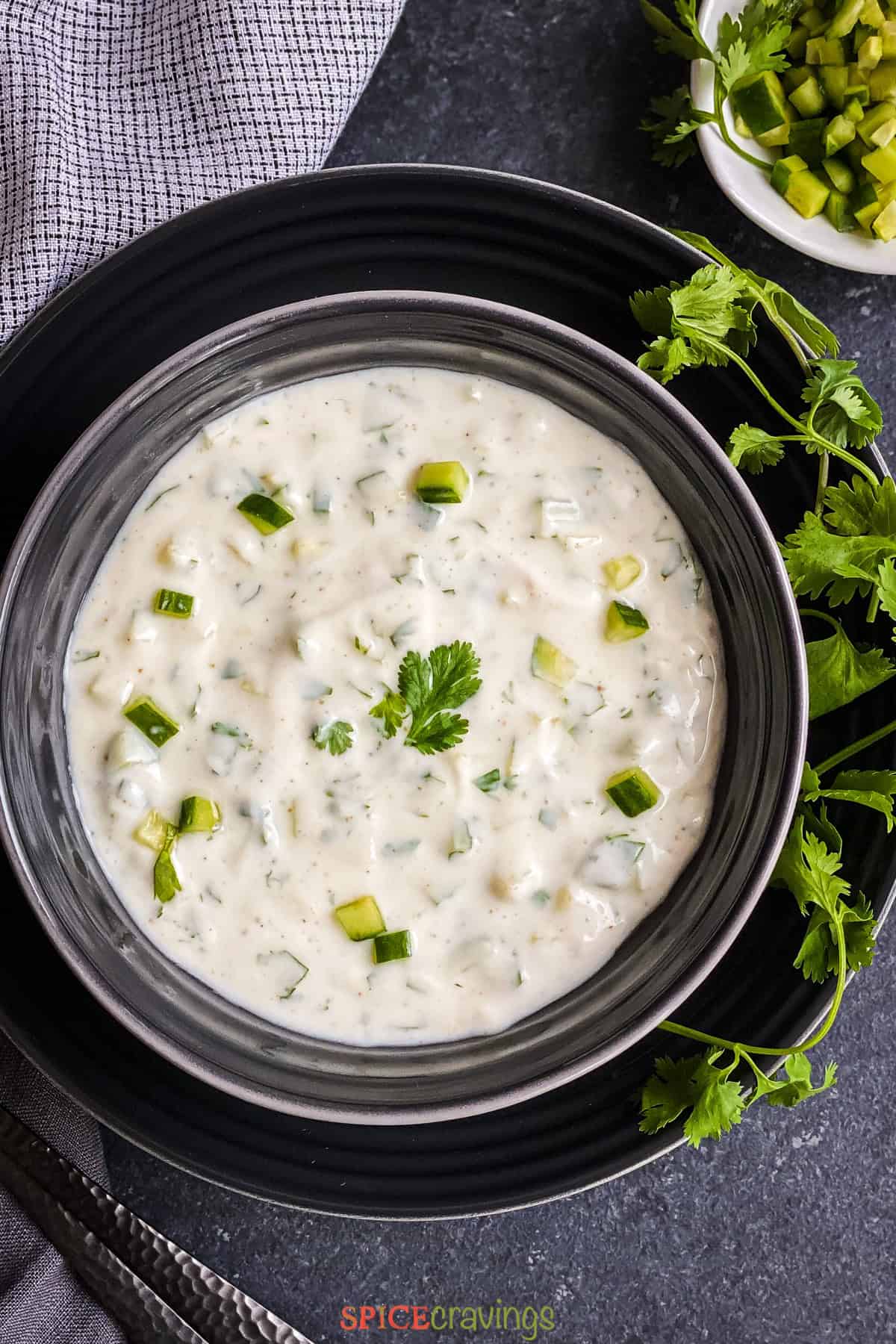
Want to save this recipe?
We’ll email this post to you, so you can come back to it later!
Ad ends in 13
Yogurt is a staple in the daily diets of many Indians. It balances the heat and warmth of the Indian spices, and in the summer months, it helps deal with the heat.
This is why raita is a common addition to everyday meals in most north-Indian homes. I love making a variety of raitas, some of my favorites include boondi raita, onion raita, and avocado raita. Today I’m featuring my kids’ favorite- Cucumber raita.
The beauty of this cucumber raita recipe is that you can serve it with just about any Indian entree. I like to think of this crunchy, zingy cucumber raita as the ultimate cooling condiment. 🙂
And the best part is that this easy cucumber raita is ready in 10 Minutes! It requires only 7 ingredients, most of which you probably already have on hand. This creamy and crunchy side is extremely versatile and can be served as a condiment (with curries, dal, and stir-frys) or as a dip (with assorted veggie sticks).
Avocado Raita (Avocado Yogurt Dip)
Mango Shrikhand (Indian Sweetened Mango Yogurt)
Shrikhand (Indian Sweetened Yogurt)
Chana Masala Tacos with Cucumber Salsa
Greek Cucumber Salad
Boondi Raita
Masala Chaas Recipe • Spiced Greek Yogurt Drink (High-Protein)
Mint Raita
Cucumber Raita is a creamy, crunchy Indian dip made with yogurt, chopped cucumbers, fresh herbs, and mild spices. This refreshing and cooling condiment is a must-have with biryani, pulao, and many Indian meals. Here’s a 10-minute recipe that can be made ahead of time, and is best served chilled.
Want to save this recipe?
We’ll email this post to you, so you can come back to it later!
Ad ends in 7
Yogurt is a staple in the daily diets of many Indians. It balances the heat and warmth of the Indian spices, and in the summer months, it helps deal with the heat.
This is why raita is a common addition to everyday meals in most north-Indian homes. I love making a variety of raitas, some of my favorites include boondi raita, onion raita, and avocado raita. Today I’m featuring my kids’ favorite- Cucumber raita.
The beauty of this cucumber raita recipe is that you can serve it with just about any Indian entree. I like to think of this crunchy, zingy cucumber raita as the ultimate cooling condiment. 🙂
And the best part is that this easy cucumber raita is ready in 10 Minutes! It requires only 7 ingredients, most of which you probably already have on hand. This creamy and crunchy side is extremely versatile and can be served as a condiment (with curries, dal, and stir-frys) or as a dip (with assorted veggie sticks).
Jump to:
What is Raita? What is Cucumber Raita?
Ingredients – Notes & Substitutions
How to Make Cucumber Raita
Serving Suggestions
How to Store
Recipe Tips & Notes
Frequently Asked Questions
More Indian Condiment Recipes
📖 Recipe
What is Raita? What is Cucumber Raita?
Raita is a popular Indian condiment made with plain yogurt that is seasoned with earthy and zingy spices, like cumin and chaat masala. The cooling elements of yogurt help balance out the heat from spices in most Indian dishes.
Cucumber raita is a type of raita recipe (yogurt dip). This popular Indian yogurt dip is made by combining freshly chopped cucumber (without seeds), cilantro and/or mint, yogurt (dahi), salt, and mild spices like roasted cumin, salt, and chaat masala.
In Hindi, cucumber is called ‘kheera’, so this raita is also known as Kheera Raita or Kheere ka Raita.
Ingredients – Notes & Substitutions
Simply gather together cucumbers and yogurt, along with Indian spices, and fresh herbs. That’s all there is to it.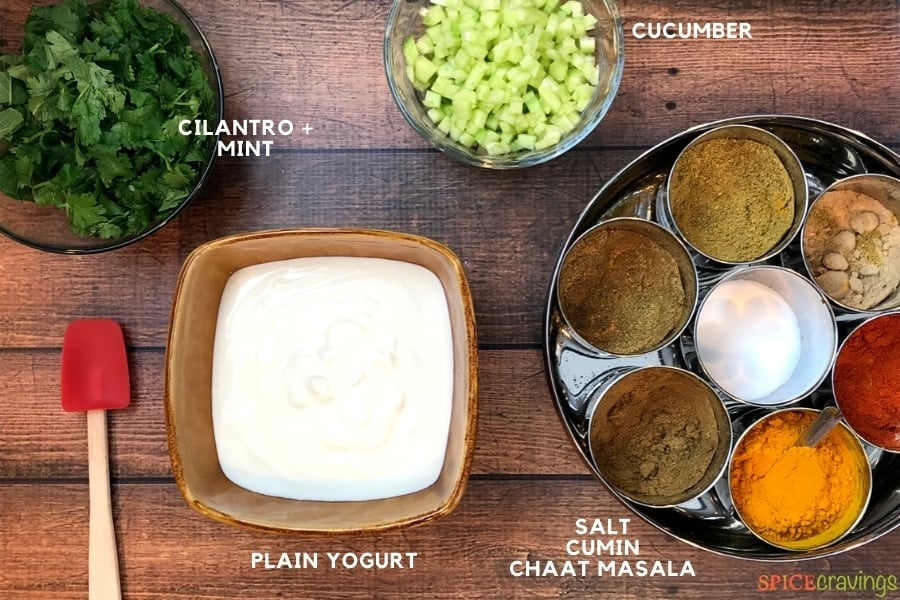
Cucumbers: I like using English, Persian or Pickling cucumbers for this recipe because I don’t have to remove the seeds, nor do I have to peel them. They are also more crunchy in taste, which adds a great contrast to the creaminess of the yogurt. If a regular cucumber is all you have on hand, simply peel and remove the seeds.
Yogurt: I use plain, 2%-fat or full-fat yogurt. I prefer using homemade yogurt, but you can use any good quality store-bought as well. Greek yogurt can also be used if you prefer a thicker consistency.
Indian Spices: Chaat masala is a spice blend that adds a zing, which compliments the cool yogurt. Roasted ground cumin, on the other hand, adds a wonderful earthiness and sweet aroma to the dip. If you can’t find chaat masala, use ½ teaspoon lemon or lime juice instead. If you can’t find roasted cumin powder, follow this easy roasted cumin powder recipe and make it at home!
Fresh Herbs: I like to use a combination of cilantro and mint since these two herbs compliment each other’s flavor. Feel free to use just cilantro instead. Alternatively, use just mint and enjoy a cucumber mint raita.
Taste Tip: Depending on the tanginess of the yogurt, you can add a pinch of sugar, too. Sometimes I add a pinch of cayenne or paprika to it to give it a kick.
There are many ways to use cucumbers in a salad. For Hungarians there is only one – a vinegary dish, garnished with sour cream – oh dear… I need to add that to this blog…
In any case, there are times when that side dish is not a good match and Moroccan Chicken with Quinoa is a case in point. I knew that meal needed a yogurt-y cucumber dish and adapted this from Epicurious. (How? much less yogurt and salt. Check the original recipe if you wish.)
It’s interesting how often cucumbers are paired with yogurt – Indian Raita (sample recipe) and Greek Tzatziki (sample recipe). This recipe is super simple and offers a blank slate if you want to be creative with your own cucumber / yogurt side dish.
The cucumber has to drain for about an hour, so account for this in your prep time. This dish can be made up to two hours ahead, chilled and covered – but bring it back to room temperature for serving
1/2 – 3/4 cups plain whole-milk thick (Greek) yogurt
1 (14-16 ounce) seedless cucumber, peeled, cored and cubed
1/2 tsp kosher salt for cucumbers
2 medium garlic cloves minced and mixed with 1/2 tsp kosher salt
Mix cucumber cubes with salt. Transfer to a sieve set over a bowl for an hour. Excess liquid should have drained from the cucumber. Taste the cucumber, and if too salty, then rinse it with water. Either way, pat the cucumber dry before the next step. Stir together 1/2 cup yogurt, cucumbers, garlic paste. Add more yogurt as desired and more salt to taste. Note: If using a regular brand of yogurt (not Greek), drain in a paper-towel-lined sieve set over a bowl for 1 hour. Discard liquid.
Yogurt (UK: /ˈjɒɡərt/; US: /ˈjoʊɡərt/,[1] from Ottoman Turkish: یوغورت, Turkish: yoğurt;[a] also spelled yoghurt, yogourt or yoghourt) is a food produced by bacterial fermentation of milk.[2] Fermentation of sugars in the milk by these bacteria produces lactic acid, which acts on milk protein to give yogurt its texture and characteristic tart flavor.[2] Cow’s milk is most commonly used to make yogurt. Milk from water buffalo, goats, ewes, mares, camels, and yaks is also used to produce yogurt. The milk used may be homogenized or not. It may be pasteurized or raw. Each type of milk produces substantially different results.
Yogurt is produced using a culture of Lactobacillus delbrueckii subsp. bulgaricus and Streptococcus thermophilus bacteria. Other lactobacilli and bifidobacteria are sometimes added during or after culturing yogurt. Some countries require yogurt to contain a specific amount of colony-forming units (CFU) of bacteria; for example, in China the requirement for the number of lactobacillus bacteria is at least 1 million CFU per milliliter.[3] Some countries also regulate which bacteria can be used: for example, in France,[4] a product can only be labeled as “yaourt” or “yoghourt” if it has been fermented exclusively by Lactobacillus delbrueckii subsp. bulgaricus and Streptococcus thermophilus, a requirement that aligns with the international definition of yogurt in the Codex Alimentarius on fermented milk
The word for yogurt is derived from the Ottoman Turkish: یوغورت, romanized: yoğurt,[8] and is usually related to the verb yoğurmak, “to knead”, or “to be curdled or coagulated; to thicken”.[8] It may be related to yoğun, meaning thick or dense. The sounds historically represented by the Arabic letter ghayn in the Turkish language ranging from a voiced velar fricative to a voiced velar plosive were traditionally romanized as “gh” prior to the introduction of a new Latin-based Turkish alphabet and the letter “ğ” in 1929, thus “yoghurt” spelled with a “gh” is first attested in sources from 1615 to 1625.[8][9][10]
In English, spelling variations include yogurt, yoghurt, and to a lesser extent yoghourt or yogourt.[8] In the United Kingdom, Australia, New Zealand and South Africa the word is usually spelled yoghurt, while in the United States the spelling is yogurt. Canada has its own spelling, yogourt, a minority variant of the French yaourt, although yogurt and yoghurt are also used.
The cuisine of ancient Greece included a dairy product known as oxygala (οξύγαλα) which was a form of yogurt.[17][18][19][20] Galen (AD 129 – c. 200/c. 216) mentioned that oxygala was consumed with honey, similar to the way thickened Greek yogurt is eaten today.[20][19] The oldest writings mentioning yogurt are attributed to Pliny the Elder, who remarked that certain “barbarous nations” knew how “to thicken the milk into a substance with an agreeable acidity”.[21] The use of yogurt by medieval Turks is recorded in the books Dīwān Lughāt al-Turk by Mahmud Kashgari and Kutadgu Bilig by Yusuf Has Hajib written in the 11th century.[22][23] Both texts mention the word “yogurt” in different sections and describe its use by nomadic Turks.[22][23] The earliest yogurts were probably spontaneously fermented by wild bacteria in goat skin bags.[24]
Until the 1900s, yogurt was a staple in diets of people in the Russian Empire (and especially Central Asia and the Caucasus), Western Asia, South Eastern Europe/Balkans, Central Europe, and the Indian subcontinent. Stamen Grigorov (1878–1945), a Bulgarian student of medicine in Geneva, first examined the microflora of the Bulgarian yogurt. In 1905, he described it as consisting of a spherical and a rod-like lactic acid-producing bacteria. In 1907, the rod-like bacterium was called Bacillus bulgaricus (now Lactobacillus delbrueckii subsp. bulgaricus). The Russian biologist and Nobel laureate Ilya Mechnikov, from the Institut Pasteur in Paris, was influenced by Grigorov’s work and hypothesized that regular consumption of yogurt was responsible for the unusually long lifespans of Bulgarian peasants.[25] Believing Lactobacillus to be essential for good health, Mechnikov worked to popularize yogurt as a foodstuff throughout Europe.
Industrialization of yogurt production is credited to Isaac Carasso, who, in 1919, started a small yogurt business in Barcelona, Spain, naming the business Danone (“little Daniel”) after his son.[26] The brand later expanded to the United States under an Americanized version of the name, Dannon.[26] Yogurt with added fruit jam was patented in 1933 by the Radlická Mlékárna dairy in Prague.[27]
Yogurt was introduced to the United States in the first decade of the twentieth century, influenced by Élie Metchnikoff‘s The Prolongation of Life; Optimistic Studies (1908); it was available in tablet form for those with digestive intolerance and for home culturing.[28] It was popularized by John Harvey Kellogg at the Battle Creek Sanitarium, where it was used both orally and in enemas,[29] and later by Armenian immigrants Sarkis and Rose Colombosian, who started “Colombo and Sons Creamery” in Andover, Massachusetts, in 1929.[30][31]
Yogurt is characterized as a viscous, shear-thinning, non-Newtonian fluid that forms when milk, a Newtonian fluid, is fermented, causing protein aggregation and subsequent gelation.[65] The result is a soft solid that can be modeled via the interactions of the casein proteins.[66] The microstructure of yogurt is affected by both the fat and protein content and the processing conditions of the yogurt. In low-fat formulations, the microstructure is a network of casein protein globules joined via clusters and strands that encapsulate pores: these pores house the aqueous phase and the bacterial cultures of the yogurt.[66][67]
Stirred yogurt formulations have a coarser distribution of loosely associated casein particulates due to the shear forces and resulting particle-particle collisions induced during the mixing process. After stirring, yogurt is more accurately defined as a weak gel.[66]
Rheology
The mechanical properties of yogurt are typically assessed using rheometry, which quantifies the deformation and flow response of soft materials subject to shear forces. As is central in materials science, the rheological properties of yogurt are dictated by a variety of processing factors, including the ratios of dry and wet matter, thermal treatments, milk origin, starter cultures, and yogurt type.[65][68]
Although cow milk is a common choice for yogurt production, other milks, such as goat, sheep, and camel, produce different rheologies. Goat milk yogurt has a low viscosity and a thinner texture when compared to cow milk yogurt.[68] Conversely, sheep milk, having higher content of solids, has a higher viscosity and thicker texture when compared to cow milk yogurt.[68]
Yogurt can further be characterized as “set” versus stirred, wherein set yogurts are processed and sold in the same container, and stirred yogurts are mixed prior to packaging in a secondary container.
How To Make Cucumber Mint Yogurt
Using a mortar and pestle, mash the whole garlic cloves and salt together. Mash the garlic cloves very finely.

Chop the cucumbers finely. Remove the fresh mint leaves and chop finely. Add the yogurt, dried mint leaves, fresh mint leaves, chopped cucumbers, and mashed garlic into the same bowl.

Mix the yogurt together. Salt the cucumber mint yogurt as desired.

Tips and Tricks
- Use Persian cucumbers. Regular cucumbers are too watery to use for this recipe. The best cucumbers to use are either Persian cucumbers (baby cucumbers) or English cucumbers.
- Use high-quality plain yogurt. I prefer to make this sauce with homemade yogurt.